Are you new around here?

Notebooks and a pencil

As there has recently been a surge of visitors coming from Moodles and other learning platforms, I thought I’d say hi — hello there!! — to everyone who is new to this blog, and provide some guidance in the form of a table of contents of sorts.

So, where have you landed at? This is a blog by me, where me = Jari Saramäki, an interdisciplinary physicist and a professor at Aalto University, Finland, dabbling in network science and other complexities, and a big fan of lucid writing. Also, a bass guitar player, because someone has to be.

The blog contains things that students have found useful (which may be why you are here), in particular, advice on how to write scientific papers and how to develop your scientific writing skills:

Welcome again, and I hope you’ll find something in this blog that is either useful or entertaining, or both!

The abstract as a tool for better thinking

Having recently spent considerable time writing abstracts for some papers-in-the-making, I thought I’d share another post on the topic, even though it has been heavily featured on this blog before.

As you may already know, I advocate for writing the abstract before the rest of the paper, contrary to what is advised by some writing guides, e.g., this one (thanks Riitta H for the tip). Why?

To me, writing the abstract is, first and foremost, an exercise in thinking, to the extent that the written abstract itself can feel almost like a byproduct.

This exercise is all about clearly understanding what the paper is about: what the research question being asked is, why it is being asked, what the outcome is, and why should someone be interested in it.

While most of these questions may have been answered when the research was designed – e.g., you don’t build an expensive experimental setup without knowing why and what for – this is not always the case. Sometimes the data lead to unexpected directions, rendering the initial question obsolete. More often than not, your perspective shifts along the way: the initial question becomes something larger or morphs into something else. But what exactly?

To figure this out, you’ll need to give the abstract a go before even considering the rest of the paper. So, how to write the abstract of a research paper? As those who have read my book or attended my writing lectures know, the abstract template that I recommend is the same as the one used by Nature. Not because it’s Nature, but because it does exactly what it should: it forces you to think clearly.

In plain language, the abstract template goes like this (sorry, Nature, for this abuse):

  1. There is an important phenomenon/topic/something.
  2. But within it, there are unknowns that need to be sorted out for achieving X.
  3. In particular, we don’t know Y, because of something that was missing until now.
  4. Here we solve the problem of Y using a clever method/experimental design/something.
  5. We discover Z, which is surprising for some reasons.
  6. Knowing Z advances our scientific field like this.
  7. More broadly, understanding Z makes the world a better place in this way.

This template helps you refine your story and the point of your paper and serves as an acid test: if you cannot write the abstract, you are not ready to write the paper. It also ruthlessly exposes any gaps in your thinking, which is excellent because it’s a template, not Reviewer #2 who gleefully rejects your paper from the journal and taunts you in the process.

Writing the abstract first using the above template helps you improve your paper on your own before it is even written (which is optimal, isn’t it).

In fact, I often try to formulate a mock abstract that follows the template during the very early stages of a research project, often well before the final results materialize. I find that this helps to understand where the project is going, and what might still be required. If I feel confused [narrator’s voice: which happens very frequently], the template sometimes shows the way.

Slides for my NetPLACE@NetSci2023 talk

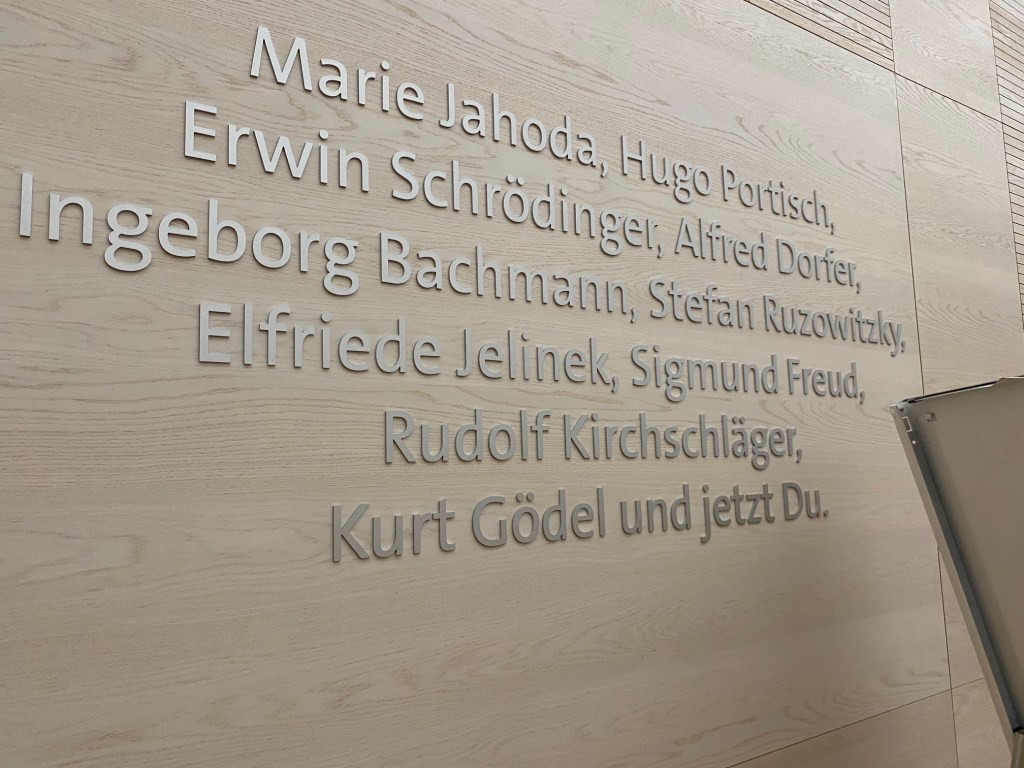
It was a great pleasure to give a short keynote on writing in Vienna (in a hall with the above text on the wall)! My slides for the talk can be accessed here.

The whole NetSci conference was excellent and it was great to meet many friends and colleagues after so many years. A great many thanks to the organizers!

Slides for my CCS warm-up presentation

The young researchers in Complex Systems Society (yrCSS) invited me to talk on scientific writing at Palma de Mallorca on October 15, 2022. It was really great to speak to an active & interested audience!

Here are the slides — I hope you find them helpful!

There is a video recording of the whole talk as well, available on YouTube. Go check it out.

Podcast interview on writing

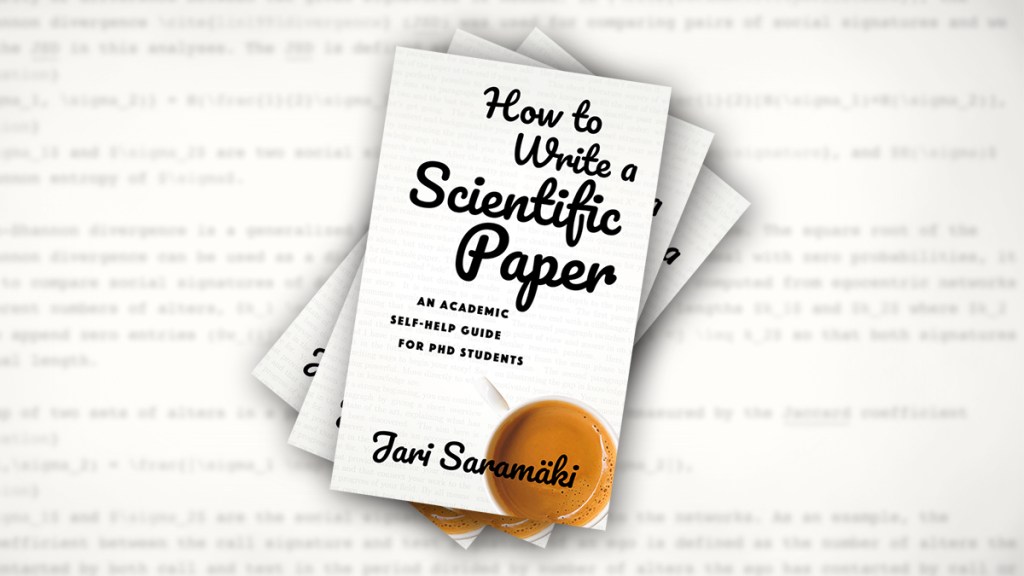
How to Write a Scientific Paper book cover

I was recently interviewed by Daniel Shea for his podcast Scholarly Communications — you can listen to the interview here: https://newbooksnetwork.com/how-to-write-a-scientific-paper

We discussed my writing book and writing in general. This was a very enjoyable discussion & Daniel had plenty of good points and new perspectives that I could immediately agree with — do have a listen, highly recommended!

How to Choose the Title for Your Paper

“Any word you have to hunt for in a thesaurus is the wrong word. There are no exceptions to this rule.” ― Stephen King
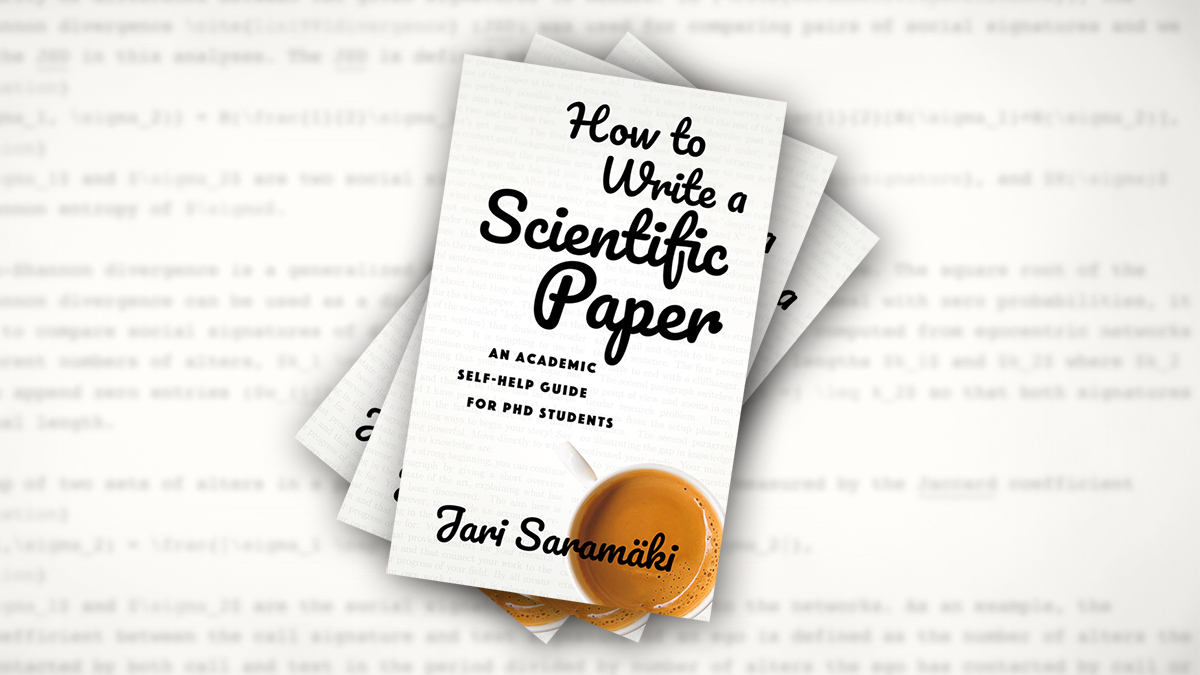
How to Write a Scientific Paper book cover

This post is a chapter from the book “How to Write a Scientific Paper.”

After you have written your abstract, the next task is to consider the title of your paper. If the abstract is a compressed version of your storyline, the title of your paper is even more so. Titles are hard—it is often surprisingly difficult to come up with a short, informative, and catchy title. For me, this has at times felt like the hardest part of writing a paper.

The title of the paper serves a dual purpose: it delivers information by telling readers what your paper is about, and it serves as a marketing tool that makes others want to read your paper. Unfortunately, unlike the abstract, there is no general-purpose formula to follow when thinking of a title. There are, however, some points that you should consider.

The title has to be in perfect sync with the abstract—they have to tell the same story. Make sure that your title and abstract use the same words and concepts. Also, make sure that everything that is mentioned in the title is discussed in the abstract.

Use words that everyone in your target audience can understand. Avoid subfield-specific jargon. Simply does it! The paper’s title should only contain concepts that can be understood on their own, without any explanation. While there is some room in the abstract for explaining one or two important concepts in brief, there is no such luxury in the title: the reader should already be familiar with every word used in it.

The title should be focused and clear. If it is possible to give away the main result in the title, do so. Avoid vague titles, such as “Investigating Problem X with Method Y”. Instead, go for something more concrete: “Investigating Problem X with Method Y Reveals Z.”

A small request: please never, ever use a title of the “Towards Understanding Problem X” variety. Just don’t do it. Pretty please. If your research is worth publishing, you have arrived somewhere. Just be confident and tell the reader where this is, instead of telling them where you would rather have gone! It is OK to say something about the bigger picture in the title, as long as your key point plays a leading role. But to keep your title concise, it may be better to describe long-term goals elsewhere in the paper.

It helps if the title is catchy as well as informative. But do not exaggerate—consider how your title will look 10 years from now. Will it stand the test of time? If the title is too gimmicky or contains a joke that becomes stale after you’ve heard it a few times, it won’t. You should also avoid jargon and buzzwords that may go out of fashion before the paper gets published.

Consider search engines and online search. Your paper needs to be found if it is to be read, so the title should contain the right keywords or search terms. As a network scientist, I almost always include the word “network” in my paper titles, even if this makes the title longer or if other network scientists would understand the title perfectly well without networks being explicitly mentioned. Without the word “network”, they would not necessarily find my paper when they hunt online for new reading material.

Keep your title short. Research has shown that shorter titles attract more citations—see Letchford et al., R. Soc. Open Sci. 2(8):150266 (2015). This should not come as a big surprise: long and cluttered titles are not as contagious as simple, focused ones. If the title is convoluted and hard to grasp, then the paper probably is too.

Sometimes there are field-specific conventions that you should be familiar with. In some biomedical fields, for example, the paper’s title often expresses just the key result—“Transcription Factor X is Involved in Process Y”—and the titles can be fairly long. In some areas of physics and computer science, shorter and less informative titles are the norm. Have a look at other papers in your field, and try to imitate their best titles.

If you get stuck at this point and find it hard to decide on the title, it might be easier to initially lower your bar a bit. Just come up with some candidate titles that do not have to be perfect. Then ask your colleagues—your fellow PhD students, your supervisor, anyone—to have a look at the list and to pick the most promising candidates for refinement and final polishing.

Get the ebook from your favourite digital store! Paperbacks are available too (Amazon only!)
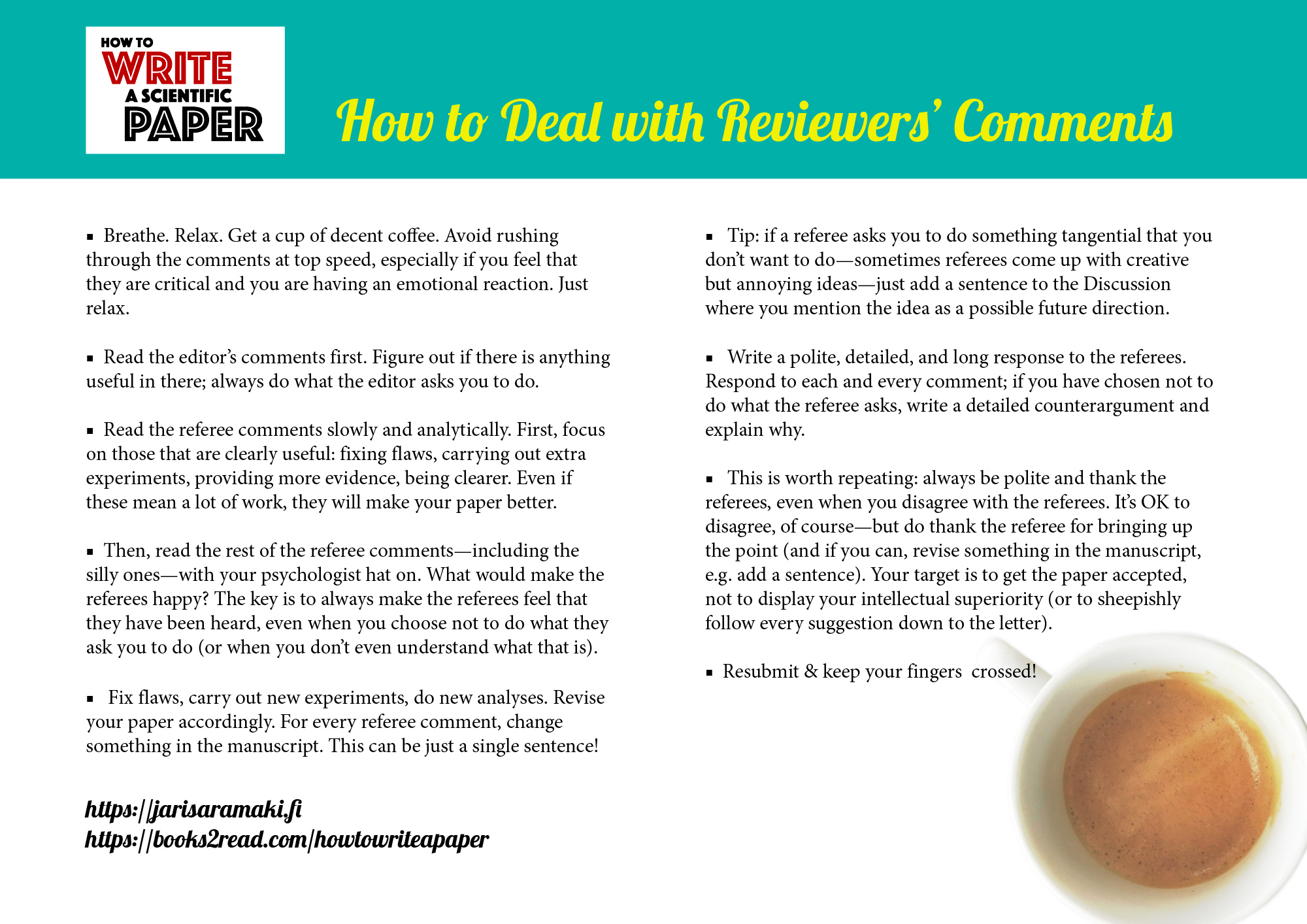
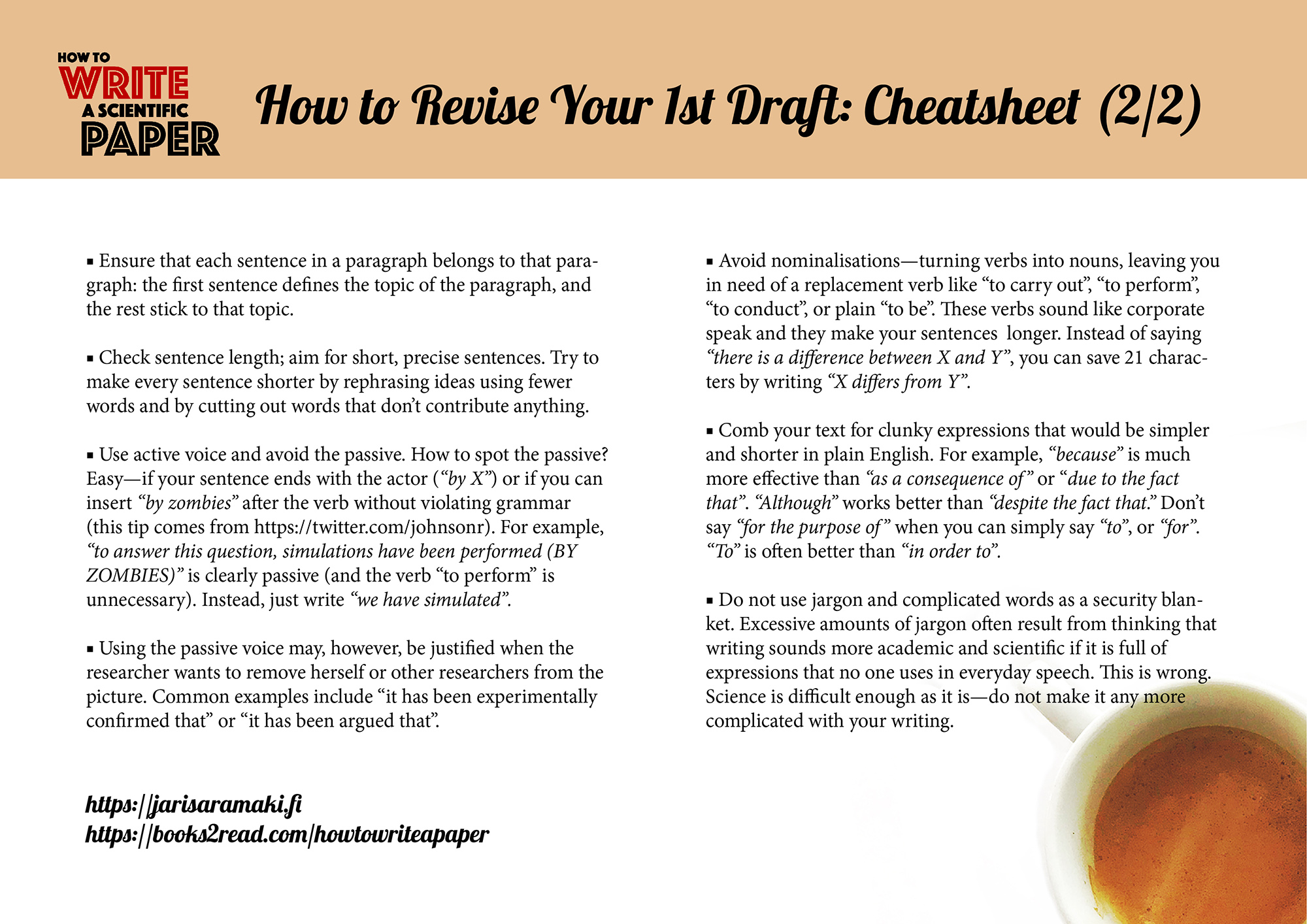
Cheatsheet: How to Revise Your 1st Draft (2/2)

Here is the second cheatsheet on how to revise the first draft of your scientific paper, focusing on sentences and words. (Here is the first one if you missed it). Enjoy!

For a hi-res PDF, please click here!

Want more? In my book How to Write a Scientific Paper you’ll learn a systematic approach that makes it easier and faster to turn your hard-won results into great papers. Or check out the series of posts that starts here.

Cheatsheet: How to Revise your 1st Draft

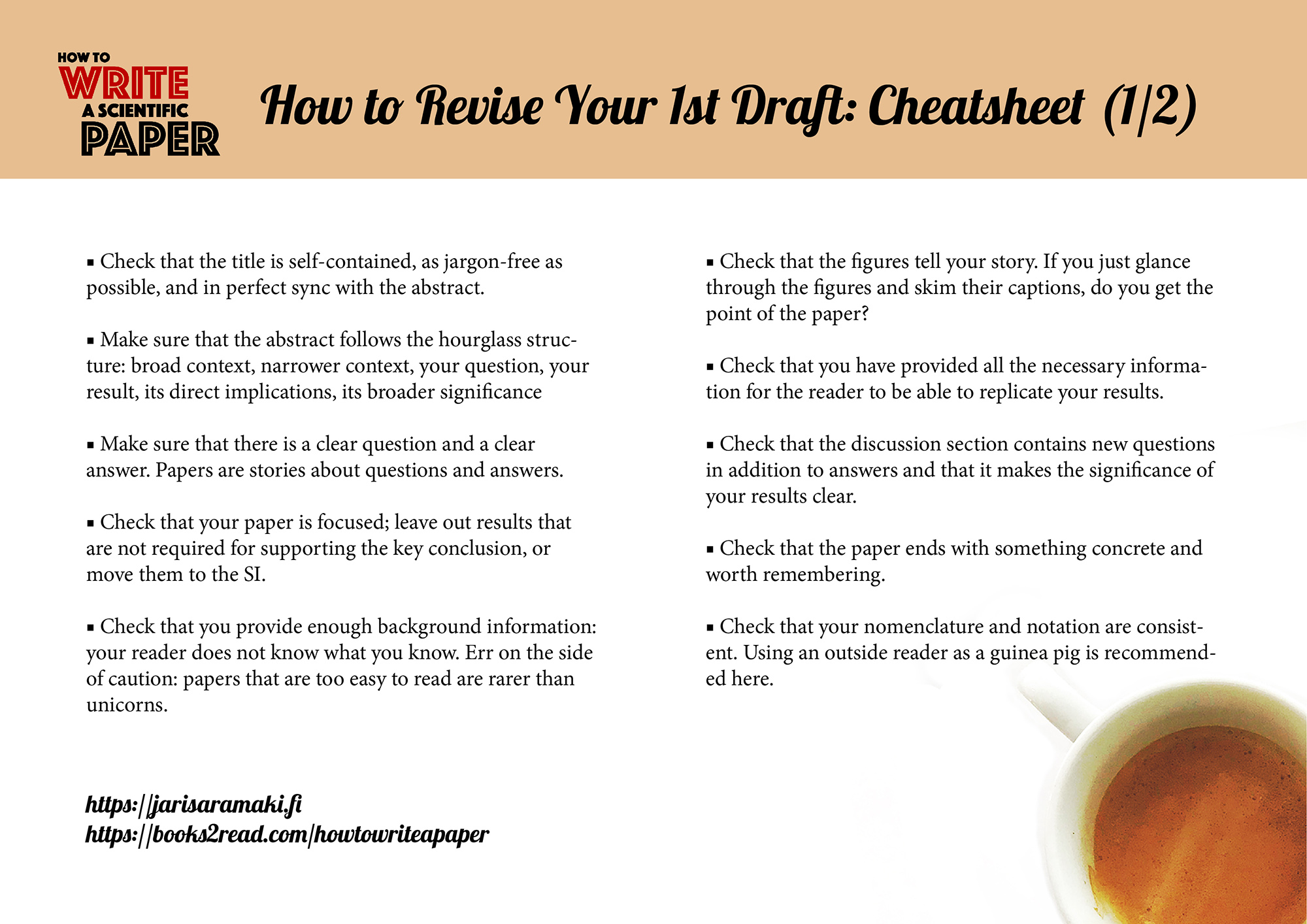
Cheatsheet: How to Revise Your 1st Draft (1/2)

Hi all,

as I hinted at earlier, I’ll be releasing a couple of cheatsheets on scientific writing based on the writing series/book, mostly because I love to play with Adobe Illustra^H^H^H because I’m sure you’ll find them useful 🙂

Here’s the first one; click here for a high-res PDF version.

Want more? Get my little writing guide where you’ll learn a systematic approach to writing papers that makes the whole thing easier, faster, and less painful: How to Write a Scientific Paper!

Cheatsheet: How to Revise Your 1st Draft

How to Write a Scientific Paper is out!

“I just wrote a (rough) first draft of a paper during a 3-hour flight, and if it wasn’t for these teachings, this would have taken me days (if not weeks)!”
— Talayeh Aledavood, James S. McDonnell Postdoctoral Fellow, University of Helsinki, Finland

Rejoice! The book based on my paper-writing posts is finally available! For the price of an espresso or two, a book that boosts your writing at least as much! Go get it!

“Following this book’s advice is painless, fun even, and before you know it, you’ll have one of the best papers you’ve ever written. If I could complain about anything, is that this book didn’t already exist 10 years ago!” — Gerardo Iñiguez, assistant professor, Central European University, Budapest, Hungary

The book is available from Amazon (as an ebook and as a paperback) and also from Apple Books, Kobo, Playster, Scribd, Tolino, and Baker & Taylor!:

(New to Kindle? You don’t need a Kindle device, there’s a free iOS/Android Kindle app)

If you enjoy the book, please leave a short review on Amazon, as reviews greatly help others find the book!

“I finally finished and submitted my first paper a few weeks ago thanks to advice
given on your website! Your new book is good news for students like me.”

— Timothee Aubourg, PhD student at Univ. Grenoble Alpes, France

“Lucky to be doing a Ph.D. in 2019 – we don’t need to learn writing as if by osmosis; we can absorb it systematically from this book!” — Tzu-Chi Yen, graduate student, University of Colorado Boulder, US