Here’s something playful for you — Baboon Song, a track I composed using temporal networks:
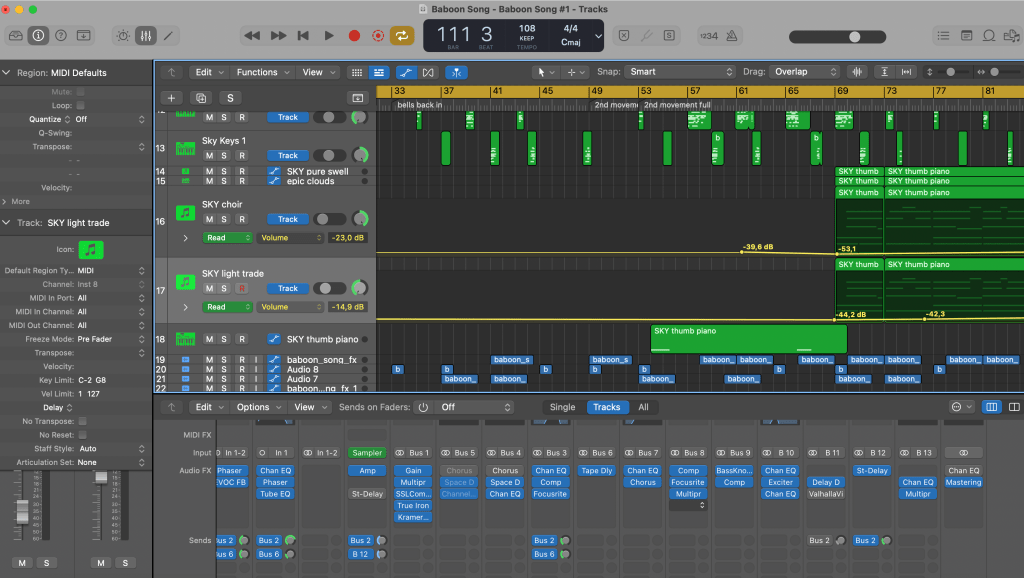
I took the Baboons’ interactions dataset from SocioPatterns, turned some baboon interaction timelines into MIDI files, chopped the files into bits, and constructed loops by feeding them into various synths in Ableton Live. I built the skeleton of the song in Ableton, added more instruments, and mixed the track in Logic Pro X (a tool I know better than Live).
The repeating rhythmic patterns are interaction timelines corresponding to a day in some baboon’s life — the pattern that starts the song is between two baboons, and the bell-like pattern that enters next is a whole temporal ego-net of another baboon. There are whispers of other ego-nets in the L and R channels… On top of the baboon sounds, I added a bit of synth bass, a few rhythmic elements, and some slightly cheesy harmony at the end of the track that I felt just had to be there, because of sunrise over the savannah or something.
Enjoy!!
PS If there is a production nerd among you who wonders — rightly so — what the beautiful, spacious reverb that everything swims in is, it’s just the default preset of Valhalla’s VintageVerb. The best reverb that there is. Rant over.
I recently gave a talk at the Complexity, Aesthetics, and Sonification workshop in Bielefeld, Germany, organized by Thilo Gross, Maximilian Schich, and Cristián Huepe. A really great workshop with lots of different points of view from art to science!
For the talk, I did a bit of exploration in representing temporal networks with sounds. As those who have dabbled with temporal networks know, visualizing them is very difficult, as they live in time instead of space. But so do sounds. Let’s hear what temporal networks sound like, then!
So what was that? That was one month’s worth of data on students’ phone calls from the Copenhagen experiment, compressed into 13 seconds. I took 10 random students and assigned each their own random pitch so that a sound is played every time the student makes a call. I then turned the time series into MIDI which was fed into one of the synthesizers of Apple’s Logic Pro X.
For such a simple and straightforward exercise, there’s a surprising amount of information in the sonification. If you are into temporal networks, you can hear several familiar patterns: there is a daily cycle, weekdays are different from weekends, and there’s also burstiness.
Let’s continue listening to these data. The Copenhagen data set contains metadata on text messages as well, so let’s pick one of the students and listen to their egonets — everyone they call or text will get their own pitch, so that, e.g., one friend is always C (on some octave). Then we’ll feed the calls into a sampler with piano sounds and the texts into another with sampled upright bass.
Quite jazzy, isn’t it? And, again, one can pick up a lot of information here. The daily cycle and the burstiness are still there — and there are even some repeated patterns, parts of temporal motifs. There is also a finding that had escaped my attention earlier — at around the middle of the timeline, there is a cluster of notes being played on the piano, as the student makes a large number of calls in a short period of time. This pattern is, in fact, present in several other students’ timelines at the very same time.
Now let’s have a bit of fun with probing the network with random walkers. I use greedy walkers — a random walker is placed on a node (student), and when the student makes a phone call, the walker moves on to the student being called, and so on. Every newly visited student gets their own pitch that is one semitone higher; when the pitch goes down during the process, this means that the walker is visiting nodes that were already visited. Let’s hear one walk, starting from a random node:
The walker explores a larger subnetwork around the starting point, sometimes backtracking, before escaping off. Now let’s hear another walk:
Quite different, right? This walker has literally become stuck in a neighbourhood of a few students who only keep calling one another and the walker cannot escape. So the social neighbourhoods of these two students are quite different indeed!
Finally, for something entirely different — the sound of criticality. This is simulated (by my student Sara Laurila): what we have is the SIS (Susceptible-Infectious-Susceptible) model on a N=50000 node network, parametrized exactly at criticality — on the boundary between two phases where in one, all activity dies out and in the other, there is persistent activity. (In the model, nodes are S until they are in contact with an I, then they become I and make others I too, until they revert back to being S, to become I again at some point in the future. So this excitement (I) propagates through the network).
In the sonification below, I again use a random sample of sentinel nodes, each assigned their own random pitch. The nodes make a sound whenever they turn I, i.e., whenever the wave of excitation hits them. Here’s what criticality sounds like:
Here’s the same but with drum sounds instead. Sounds like Zappa, but without intention or direction, as a drummer friend of mine remarked.
And finally, criticality from the point of view of one single sentinel node:
Rejoice! There is a new book on temporal networks coming out soon — Temporal Network Theory, edited by Petter Holme & myself. A lot has happened in temporal-network research since our first edited volume (Temporal Networks, 2013); in this new volume, we wanted to focus on the theoretical side of things & invited contributions from many pioneering scientists & groups.
As a teaser trailer, here is a list of the book’s chapters:
A Map of Approaches to Temporal Networks—Petter Holme and Jari Saramäki
Fundamental Structures in Temporal Communication Networks—Sune Lehmann
Weighted, Bipartite, or Directed Stream Graphs for the Modeling of Temporal Networks—Matthieu Latapy, Clémence Magnien, Tiphaine Viard
Modelling Temporal Networks with Markov Chains, Community Structures and Change Points—Tiago P. Peixoto and Martin Rosvall
Visualisation of Structure and Processes on Temporal Networks—Claudio D. G. Linhares, Jean R. Ponciano, Jose Gustavo S. Paiva, Bruno A. N. Travençolo, Luis E. C. Rocha
Weighted Temporal Event Graphs—Jari Saramäki, Mikko Kivelä, Márton Karsai
Exploring Concurrency and Reachability in the Presence of High Temporal Resolution—Eun Lee, James Moody, Peter J. Mucha
Metrics for Temporal Text Networks—Davide Vega and Matteo Magnani
Bursty Time Series Analysis for Temporal Networks—Hang-Hyun Jo and Takayuki Hiraoka
Challenges in Community Discovery on Temporal Networks—Remy Cazabet and Giulio Rossetti
Information Diffusion Backbone—Huijuan Wang and Xiu-Xiu Zhan
Continuous-Time Random Walks and Temporal Networks—Renaud Lambiotte
Spreading of Infection on Temporal Networks: An Edge-Centered Perspective—Andreas Koher, James P. Gleeson, and Philipp Hövel
The Effect of Concurrency on Epidemic Threshold in Time-Varying Networks—Tomokatsu Onaga, James P. Gleeson, and Naoki Masuda
Dynamics and Control of Stochastically Switching Networks: Beyond Fast Switching—Russell Jeter, Maurizio Porfiri, and Igor Belykh
The Effects of Local and Global Link Creation Mechanisms on Contagion Processes Unfolding on Time-Varying Networks—Kaiyuan Sun, Enrico Ubaldi, Jie Zhang, Márton Karsai and Nicola Perra
Supracentrality Analysis of Temporal Networks with Directed Interlayer Coupling—Dane Taylor, Mason A. Porter, and Peter J. Mucha
Approximation Methods for Influence Maximization in Temporal Networks—Tsuyoshi Murata and Hokuto Koga


 Jari Saramäki