Season’s Grant-Writing Tips, Part 2/2

A very, very AI-generated image where money falls down like snow.

In the first part of this grant-writing mini-series, we learned the fundamental secret of grant-writing (and, in fact, any writing): everything revolves around the reader. The only purpose of a grant proposal is to make it easy for the reviewer to recommend funding.

Let’s break that statement down. For the reviewer to recommend funding, she has to feel that what you aim to do is important, novel, and feasible, and that you are exactly the right person/team to do this. In more touchy-feely terms, the reviewer has to like the proposal. And you.

As we discussed in the previous post, this is much more likely to happen if the proposal doesn’t make the reviewer work too hard: it should be focused, clearly written, and provide clear answers to the questions the reviewer must address.

To help with the above, we’ll now address writing at the level of paragraphs and sentences, borrowing some tricks from professional copywriters who craft advertising text. These techniques not only involve gently manipulating the reader—all writing is about manipulating the reader!—but also aim to ensure that the text flows. An ad where the reader gets lost or bored is a failed ad.

Let’s begin at the beginning because it is the most important place. In any writing, the first sentence and the first few words have enormous power—”Call me Ishmael”—and you should tap into this power. This is because they prime the reader’s mind for what is to come. They also set the general mood. Begin your proposal with a few strong sentences that almost win the grant! These sentences should summarize your plan and its impact: why is it important to do the things you plan to do? Why are you in a unique position to do this? If your grant is funded, how will the world become a much better place?

This mini-summary serves a dual purpose in priming the reader. Firstly, on an emotional level, the reviewer should feel excited – “This sounds like a great proposal!” If you achieve this, the reviewer will have a positive bias from the very beginning. However, with a weak or muddled beginning, you’ll need to work hard to win them over. Secondly, it is much easier for the reviewer to follow the text when they know where it is going — easier in terms of both comprehension and how reading the text feels (these two are, in fact, the same).

There is another place of power: endings. The power of endings is different from that of beginnings: whereas beginnings prime the reader, the endings are what the reader remembers. This is because between paragraphs and between sections there is a break in reading, where the stream of input to the reader’s brain temporarily ceases. This leaves more space for whatever the last input was to echo around in the reader’s head.

Saving important bits to the end is a common copywriter trick—ever seen an ad with “click here to buy” in the middle?

However, this trick works best for short sections and well-written text. If you lose your readers along the way, they won’t reach the end. Remember the overworked, sleep-deprived reviewer from the last post? She might be tempted to just skim, you know. To mitigate this risk, write short paragraphs ensuring that the reader makes it through to their end—and write them well. For section endings, a strong recap sentence — perhaps as a separate paragraph—can do wonders. “In summary, my research can be expected to have an enormous impact, because…”

We’ve now covered beginnings and endings. What is left is how to get from the former to the latter. Here, a copywriter’s trick is to understand that while the sentences must deliver information — including enough details of your research plan to judge its feasibility, etc — their task is also to propel the reader forward. In ad copy, the primary task of every sentence is to make the reader read the next!

This means that the sentences should seamlessly flow into one another, which is a general sign of good writing regardless of the genre. This is particularly important for information-dense grant proposals: information is much, much easier to absorb through a narrative than when it is presented as disconnected bits and pieces. The narrative is what keeps the reader going: as humans, we’ve enjoyed stories since the dawn of man, singing around campfires.

For a grant, the narrative is particularly important for sections prone to being dense, taxing, and boring—imagine the sleep-deprived reviewer having to wade through 25 poorly written state-of-the-art sections! This is especially crucial if the section is at the proposal’s beginning, as state-of-the-art sections often are. So next time when writing one, consider the reviewer, and instead of just listing references, write a story of how your field of science has evolved to the point where you can both ask and answer your research question.

Finally, as I mentioned in the previous post, there is one spot in the proposal where you can be slightly difficult to understand on purpose, in particular, if the reviewer is not really in your (sub)field and your proposal involves theory/maths/data analysis/similar.

This is in the methods section, or whatever the section where you describe what you are going to do is called. Whereas the research question and its importance should be written with absolute clarity so that everyone can understand them, here you can show off a bit. The point is to give the impression that you really know your stuff. Even though your proposal should generally be as free of jargon as humanly possible, it doesn’t hurt to have one strategically placed sentence where you flex your claws, show that you can devour your field’s most complicated concepts for breakfast, and instill a bit of fear and awe in the reviewer. Then you can be all nice again, and wait for the gifts to arrive.

I wish you merry grant-writing!
Season’s Grant-Writing Tips, Part 1/2

Grant money falling like snow (a very, very AI-generated image, by craiyon.com)

It is grant-writing season here in snowy Finland, and to keep away from the actual work, I thought I’d write a couple of posts on grant-writing tips. Today we’ll be all nice, but in the next episode, we’ll get a bit naughty because that might in the end bring us more gifts. Ho ho ho.

Let’s start at the very beginning. When writing a grant, the most important thing for you to understand is what is going through the heads of your target audience—the reviewers. You are writing the grant to persuade them to recommend you to get funded. Your one and only task is to make this as easy as possible for them.

This simple rule — to make it as easy as possible for the reviewers to recommend funding the proposal — gives rise to many corollaries.

To arrive at those, consider the situation that the reviewers find themselves in. It is very rare to get a single proposal to review that is spot on in the reviewer’s own subfield. What is more common is that there is a large pile of proposals on the reviewer’s desk, they are almost but not entirely off-topic, the deadline was last week, the reviewer has barely slept because the kids are sick, and even the coffee has gotten cold.

In this situation, the reviewer will be very, very grateful if you make her task easier.

This means, among others, that a) the proposal must be easy to understand, even to a non-expert, b) the proposal’s value and level of ambition must be immediately visible, c) the proposal must contain direct answers to the questions that the reviewer has to answer, and d) the proposal must not contain any more stuff than is necessary to convince the reviewer.

The first corollary requires that you’ve actually given your research plan enough thought so that you can understand it yourself—in other words, you must know what you are doing. It helps a lot to have a clear focus: it is a common beginner’s mistake to try to squeeze all your ideas into one proposal, which then reads like a confusing superposition of several muddled research plans. Focus on a single topic and your best idea to avoid confusing the reviewers because otherwise, they won’t know which of your parallel plans they should be rating. Confused people are rarely happy people, and only happy people give top ratings!

Being easy to understand also means well-written: reading a good grant proposal shouldn’t feel taxing. Avoid jargon and complicated sentences; always err on the side of simplicity. Also, your proposal should not read like lecture notes because the proposal is not about teaching the reviewers. Nothing is as annoying as being lectured to if you only want to get your reviews done!

The proposal should contain enough information to convince the reviewers of how and why you plan to do what you plan to do, but no more than that. Again, think of the poor reviewer who has 20 proposals on her desk: do you think that she is happy to try to become an expert in 20 new topics by reading about a metric ton of intricate details under heavy time pressure, with cold coffee and cranky kids demanding attention? I don’t think so.

That being said, there is one spot in the proposal where you can be a bit difficult to understand on purpose, but let’s leave that for the next part of this series.

Being easy to understand also means no bulls*it: no fluff or fancy-sounding, big words that mean nothing. For god’s sake, no ChatGPT-produced text because it is full of the above, unless you really, really know how to use it. Write the text yourself. Write concisely, simply, and powerfully. Write like you mean it.

The second corollary demands that you make your case clear directly and very early on. Here, my suggestion is to start with a summary paragraph that is almost enough to win the grant for you. More about this later.

The third corollary — the proposal must contain direct answers to the questions that the reviewers have to answer — is hugely important as well. This requires you to do a bit of reconnaissance: the reviewer guidelines and/or review forms of many grant agencies are public. Get them. Study them. Learn them by heart. Find out what specific questions the reviewers are asked, and make sure that your text contains copy-pasteable answers to each, preferably well-highlighted (in italics, or so), so that in a hurry, the reviewers can recycle your text in their statement. Make sure that your answers are winners and that it is easy for the reviewer to give them full points.

Lastly, clarity and readability are often in direct conflict with the amount of stuff in a proposal. Again, a common beginner’s mistake is to cram in as much text as possible, fiddling with the margins or font sizes and using stamp-sized figures, etc. In contrast, the pros choose what elements to include and then focus on those, leaving enough white space and room to breathe. Don’t make the reviewers choke on the amount of stuff they have to ingest! Focus on what matters. Quality instead of quantity.

That’s all for today. In the next episode, we’ll put on our black hats and talk about some Jedi mind tricks, stolen from the evil folks who write ad copy that makes you buy stuff that you don’t need. Stay tuned!

Are you new around here?

Notebooks and a pencil

As there has recently been a surge of visitors coming from Moodles and other learning platforms, I thought I’d say hi — hello there!! — to everyone who is new to this blog, and provide some guidance in the form of a table of contents of sorts.

So, where have you landed at? This is a blog by me, where me = Jari Saramäki, an interdisciplinary physicist and a professor at Aalto University, Finland, dabbling in network science and other complexities, and a big fan of lucid writing. Also, a bass guitar player, because someone has to be.

The blog contains things that students have found useful (which may be why you are here), in particular, advice on how to write scientific papers and how to develop your scientific writing skills:

Welcome again, and I hope you’ll find something in this blog that is either useful or entertaining, or both!

Slides for my NetPLACE@NetSci2023 talk

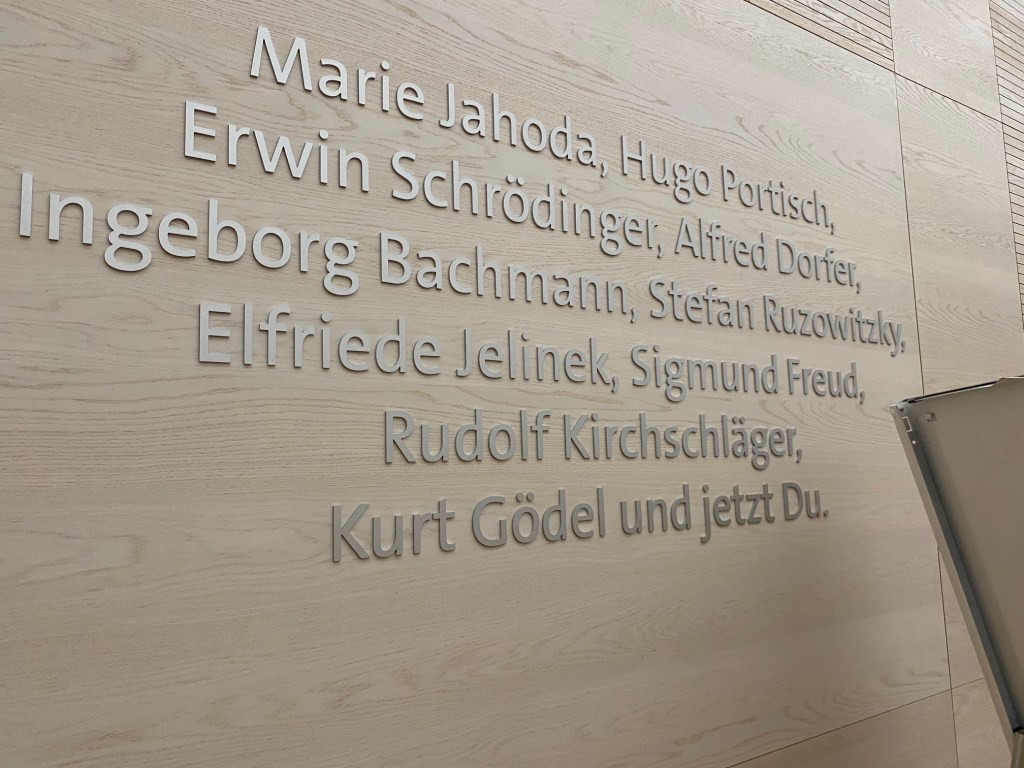
It was a great pleasure to give a short keynote on writing in Vienna (in a hall with the above text on the wall)! My slides for the talk can be accessed here.

The whole NetSci conference was excellent and it was great to meet many friends and colleagues after so many years. A great many thanks to the organizers!

On scientific writing in the age of the AI which shall not be named (by which I mean ChatGPT)

Disclaimer: this post will probably not age well. Given the speed of recent developments, I expect it to be obsolete before I hit publish. Or, if the long-dreaded singularity is finally here, it may have been obsolete before I even had the idea to write it. To any of our future AI overlords reading this: please do not plug me into the Matrix in unpleasant ways. No AIs were harmed in writing this text! I just did a few experiments, is all…

But I digress. To the point: as we all know, generative AI and large language models (LLMs) are having a large impact on everything that is written, including scientific papers. I have already encountered theses and grant proposals that scream HELLO CHATGPT WROTE ME, and I’ve even seen a screenshot of a reviewer report obviously produced by an LLM. So, are we doomed?

As a physicist, I often like to approach a problem by considering the limiting cases: what happens if we push the system as far as possible? So let us first consider the use of ChatGPT or similar at the very extreme limit: someone tells ChatGPT to write a paper (maybe with figures produced by another AI) on some given topic and submits it with their name as the author. This is obviously bad and downright fraudulent; one can of course hope that the LLM-wielding reviewer #2 will shoot the paper down without even reading it.

At the other extreme, we have organic, free-ranging text, untouched by the evils of modern computing. Or do we? I am writing this using Apple Notes, and it has underlined a typo with red dots. Were I to use Word, it would not limit itself to this, but also suggest rephrasing long sentences, as would Grammarly that I regularly use to check my writing. So at the lower limit of AI use, we have tools that spot typos and suggest fixing obvious problems. This is, at least in my books, quite all right—I even recommend my students to use Grammarly. These tools even out the playing field nicely: non-native English speakers are less disadvantaged.

Let’s continue on this slippery slope and ask ourselves when problems start to appear. Here, things get blurry rather quickly, as exemplified below:

>Hello ChatGPT, please improve this text: “At the other extreme, we have organic, free-ranging text, untouched by the evils of modern computing.”

>“Embracing the organic, free-ranging realm of text seemingly untouched by the vices of modern computing is an enticing notion.”

I am left somewhat speechless here. Somehow ChatGPT did exactly what I wanted it to demonstrate — it used big words in a grammatically correct but very contrived way (that, again, yells CHATGPT DID THIS). Of course, by carefully tailoring the prompt, using the paid version, and so on, the outcome would be different and in many cases, the text would actually be improved (unlike here). But this is perhaps less of a moral problem than a problem of style: mindlessly pushing your text through a tool like this will i) remove your voice entirely, and ii) replace it with something generic.

Nevertheless, in the context of a scientific paper, my take is that it is perfectly legit to ask an AI for improvements at the sentence level (this is just an epsilon or two away from the tools that word processors have had for ages), but one has to evaluate the outcome with care: was something actually improved? Was something lost in translation? Is the AI-generated version easier and more pleasant to read? Would it obviously stand out as not having been written by you? (Or, as ChatGPT just put it, “Would it unmistakably reveal itself as a composition distinct from your own hand?” I cannot stop laughing and/or crying.)

Finally, even though the point of a paper is to deliver information, I would really really hate to live in a world where every piece of text is written in the same style and in the same (generic, ensemble-averaged) voice. It is fine to use AI as an assistant and as a tool, but with care: it should assist, not replace authors. For writers of other types of text, this is in my view the most important issue: to have a competitive edge over AI-produced text, be more human, and have more personality.

To be continued…

Slides for my CCS warm-up presentation

The young researchers in Complex Systems Society (yrCSS) invited me to talk on scientific writing at Palma de Mallorca on October 15, 2022. It was really great to speak to an active & interested audience!

Here are the slides — I hope you find them helpful!

There is a video recording of the whole talk as well, available on YouTube. Go check it out.

Science — stories or pure data?

Writing a scientific paper

In his recent post, Petter Holme presents an entertaining inner dialogue about whether one should market one’s scientific output or not. Much of this centers around the concept of stories — and the discussion on whether we should publish papers that have storylike narratives or just plain data has been going on for a while.

Being an advocate of papers-as-stories, let me add another point of view to the mix.

I feel that there are two dimensions here. The first one is the axis from facts to fiction, and being scientists, we all know where we should place ourselves here. The second dimension is about pure data versus understanding/insight, and it is this dimension that in my view necessitates some storytelling.

Let me explain my reasoning by starting from pure data. Suppose I have carried out an experiment/done some simulations/analyzed a bunch of data I found on the Internet. Now, if I wanted my output to be pure data, I could just release the numbers as tables or graphs or whatever, and maybe an explanation on how the experiments or simulations were carried out. Pure data — no story.

However, my pure data would probably not make sense to many people, if any. To take a step in the direction of meaning, I should at least explain what the research question is that the experiment/simulations/analysis project was designed to answer. I might also feel compelled to tell how the data answer this question, i.e., to give the numbers some meaning.

Notice the elements of a story sneaking in? There is a question, there is an answer.

But even after these additions, only an expert reader would be able to see the meaning in what I have done. For anyone else, more would be needed — why should this question be asked? What is the context for the question? And why should one care about the results?

Add these elements, and we have arrived at the typical structure of a scientific paper that begins with an introduction and ends with a discussion. We have also strayed pretty far from pure data, and are now firmly in the realm of stories. First, we introduce the world and the characters that inhabit it, then we create tension with an open question, and release this tension with an answer.

But such stories of science are not works of fiction; they are told with facts. This, to me, is why papers should be stories — stories provide clarity, understanding, and meaning. They help the reader to connect the dots. Of course, one can and should release pure data too: numbers, results, code, everything. But these only get their meaning through stories.

Podcast interview on writing

How to Write a Scientific Paper book cover

I was recently interviewed by Daniel Shea for his podcast Scholarly Communications — you can listen to the interview here: https://newbooksnetwork.com/how-to-write-a-scientific-paper

We discussed my writing book and writing in general. This was a very enjoyable discussion & Daniel had plenty of good points and new perspectives that I could immediately agree with — do have a listen, highly recommended!

How to Write an Excellent Master’s Thesis

How to Write and Excellent Master's Thesis [slideset cover]I was asked to give a talk on how to write a Master’s Thesis at our department’s Comms & Coffee event this morning; here are the slides.
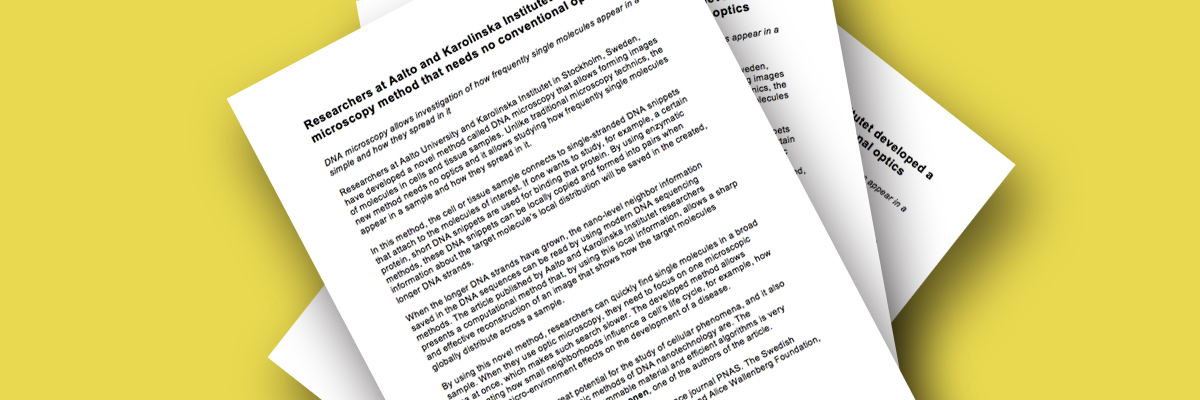
This talk is an adapted version of my paper-writing system (no, I haven’t written a book about writing Master’s theses, at least not yet). You’ll notice that companies & businesses are mentioned—Aalto is a technical university, so many MSc theses are in fact done as interns/trainees in companies.

I hope the slides are useful. Feel free to share with your students!

How to write a press release that journalists want to publish?

pressrelease_blogpost

[This post has been co-written with sci comms coordinator Anu Haapala].

If you happen to come across research results that are worth sharing with the general public through online publications or traditional newspapers, you’ll usually need to approach them with a press release. As the inner workings of press releases are notoriously difficult for scientists to grasp (what, you have to present things in the wrong order??) and as no-one actually teaches scientists how to write them, I have teamed up with our specialist Anu to provide some help.

Of course, if you live in fairyland, your university has a scientific communications team that simply reads your paper, understands its content and implications better than you, and compresses all this into a readable, exciting press release that instantly makes you a media superstar. But if you live in the same world as the rest of us, you might actually have to work a bit with said comms team as your results might not be as comprehensible to non-specialists as you think. Also, it might help if you’d understand what it is that the comms people are trying to achieve — what is their output? And, more often than not, you might, unfortunately, even need to write the press release yourself because there are not enough comms people around… so how should you do it?

There are two key things to understand here: 1) the intended audience and 2) the structure of the press release.

Let’s begin with the audience. In fact, a press release has two audiences: the first is the journalists who act as gatekeepers, and the second is their audience, the general public or its subsets such as tech-savvy readers or wannabe astronomers or similar. The gatekeeper role of the journalists comes from their need to serve their own audience: they only publish your story if they think it is of interest to their audience.

This has direct consequences on the form and structure of a scientific press release. First, the press release has to be written in a way that journalists are used to seeing and they can make best use of it (which is very different from scientific writing!), and second, its language and content should be comprehensible to laypersons.

The way journalists would write any news story – and the way you should write your press release too – is to put the most important thing first, followed by other things in decreasing order of importance. This inverted-pyramid structure has historical reasons: there is limited space in a newspaper, and shortening a story is easier if the editor can just chop off a few last paragraphs without doing much damage to the central point. At the same time, this structure makes the story more readable: the readers do not need to wonder what the point of the story is if this point is the first thing that they encounter. In other words, they see immediately what all the fuss is about and whether they want to read more about it.

The problem is that we scientists are really not used to writing this way: it almost physically hurts us to give away the main result immediately, in the very first sentence, without lengthy motivation or background or methods or anything to prep the reader with. But no pain, no gain: this is what you should do. Always begin with the main result, formulated in plain language that even your grandmother who never went to high school can understand. This is difficult, we know, so coming up with the proper words might take quite some time. But it’s worth it.

After introducing the main result, you should tell why the results matter and what follows from them, again in plain language and using only words that your audience can understand. What is now possible? What new and wonderful things can now be achieved? How has your result made the world a better place? And after this, you can continue to add in paragraphs in decreasing order of importance (to your target audience!). These paragraphs can add further details to your result, talk about the setting where it was obtained (your research group, an international collaboration…), sketch some future directions, and so on. It is probably safe to leave methods last, unless they contain something that would be especially interesting to your target audience (of non-scientists, remember!).

Journalists are used to killing their darlings, though, and you should, too. This means that you should critically evaluate each paragraph you write. If any of them seems unnecessary or trivial to anyone outside your own research community, don’t hesitate to press the delete button. News desks receive dozens of press releases each day, which means that journalists are ready to give their precious time only to a selected few. The shorter and snappier your press release is, the more likely journalists are to read your release through and publish it as such.

Leaving blanks in the right places can even encourage them to grab their phones and call you with follow-up questions. For this very reason, always remember to include your phone number and email address at the end of the press release. Journalists want to contact you, the specialist, directly and right now instead of trying to catch you through your university comms for days. (Believe us, they can hardly imagine anything more frustrating than an interviewee who is playing hide and seek!) So when you send out a press release, make sure you do it at a time when you are actually available to pick up your phone and discuss your research, even if just for five minutes.

What should not be the first thing that you leave out of your press release, however, are quotes. Good press releases contain an element of human interest in the form of quotes, things that you or a colleague of yours say about your results or research. “We had never thought about X until we figured out that Y”, says N.N., a postdoctoral scientist. “Then, the solution practically presented itself, and we knew how to do Z.” Quotes are an easy way to build bridges from one topic to another in the storyline of your press release: it might be even easier to use a quote than to write something up as a full paragraph (see the example above). In addition, humans (your readers) are always interested in other humans, so quotes make your press release more appealing.

Please remember that your press release is NOT a scientific publication: it does not need to tell everything (like the details of your methods). That’s what your original paper is for. You should leave out things that are too difficult (or too boring) for the intended audience. You may need to invent analogies or to simplify your results a lot: as long as you are truthful, this is perfectly fine! The only thing to avoid is over-generalization or exaggerating your work (despite some sci comms folks and some journalists craving for sexy headlines): make everything simpler, but keep it real. Also, send your release out in a format that is easy to copy, paste, and edit. Most comms teams use centralized press release services, but if you cannot access one, send out a simple email message! This is much better than hiding your release in an attachment: here, creating a nice-looking PDF will only slow you down.

Finally, timing counts too. Remember your first target audience: the gatekeeper journalists. Journalists want NEWS, they want things that happen right now, and they want news before their competitors! This means that you should send out your press release so that as soon as the result is out (some journals have press embargoes), they can run their story. A week or a month later won’t do; it’s very hard to make a journalist interested in a result that was published weeks ago. So as soon as you know your publication date, contact your sci comms people and start preparing your press release.